Table of Contents
The push for free AI in India sees companies offering premium subscriptions at no cost to capture users rapidly, harvest behavioral data, and secure a long-term strategic position in one of the world’s most important digital markets, rather than out of pure generosity.
India is the perfect AI testbed
India is the world’s highest consumer of mobile data per user and is on track to exceed 900 million internet users, making it an exceptionally attractive market to seed free AI in India initiatives at scale. This growth is fuelled by data, deep smartphone penetration into rural areas, and a large, digitally savvy youth population comfortable experimenting with new apps and services.
Telecom giants like Airtel and Jio act as powerful distribution rails, bundling free AI in India plans directly into mobile and broadband offerings so that AI tools reach tens of millions of users almost overnight. For Google, OpenAI, Perplexity and others, partnering with these operators is the fastest route from experimental product to mass adoption for free AI services across India.
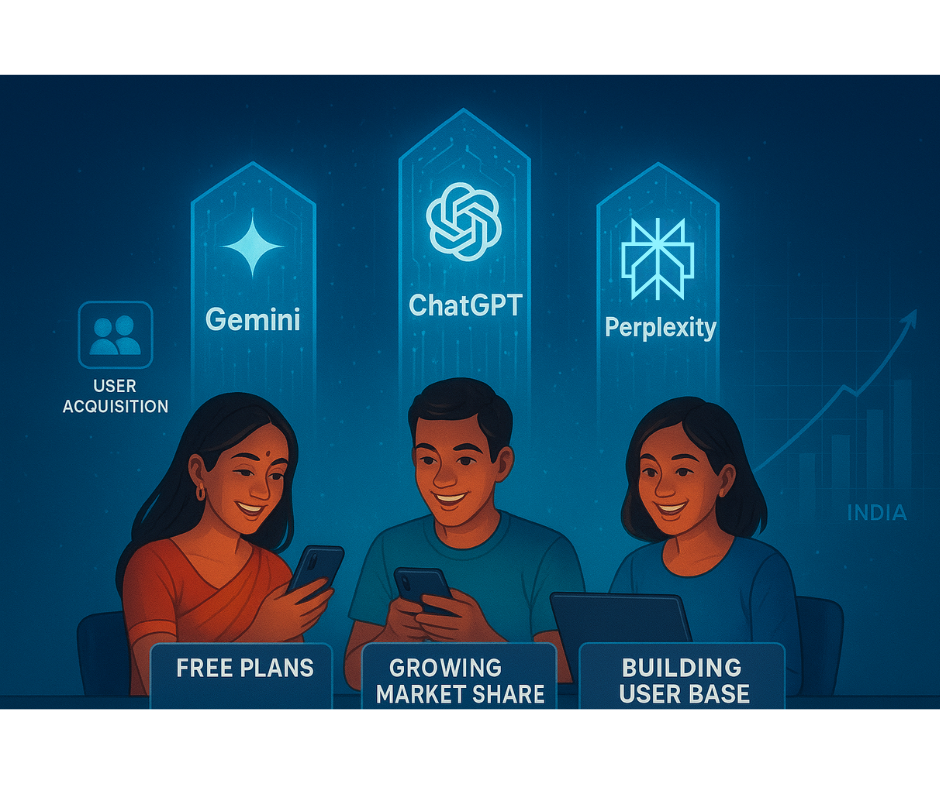
Strategic goals behind free AI in India
Free AI subscriptions help companies build habits and lock in before competitors can dominate similar use cases. Just as free search, email, or cloud storage created sticky ecosystems in the past, long-duration AI trials are designed to make users dependent on assistants embedded across work, study, and daily life.
At the same time, these offers grow user numbers and engagement metrics that directly support sky-high valuations and fundraising. Perplexity’s valuation reaching around 20 billion dollars in three years, and OpenAI’s hundreds of millions of weekly users, illustrate how quickly user growth in markets like India translates into financial power.
Free AI in India: The Data, Training, and Hidden Costs
Every interaction with chatbots, image tools, and copilots can become training data to improve future AI models. Public web content, social media posts, voice recordings, and user chats are all potential inputs, supplemented by large web crawls and resources like Common Crawl. India’s scale and linguistic diversity make it especially valuable for building models that can handle many languages, dialects, and real-world use cases.
However, this data-centric strategy has triggered criticism and lawsuits over copyright and scraping, including actions against Perplexity, OpenAI, and others by major publishers and platforms like The New York Times, The Chicago Tribune, Reddit, and media groups worldwide. Many creators argue that their content is being used to train and power AI systems without adequate permission, compensation, or transparency.
Legal and ethical grey zones
For the landscape of free AI in India, the regulatory framework remains uncertain. India currently lacks a dedicated AI law, and its Digital Personal Data Protection Act 2023 is not yet fully in force and does not directly regulate AI systems or algorithmic accountability. This creates uncertainty about how personal and sensitive data used in AI training will be governed, especially compared to stricter regimes such as California’s privacy laws or the EU’s AI Act, which impose controls and outright bans on certain high-risk uses.
Once data has been absorbed into a trained model, there is presently no practical way to make an AI system “forget” specific information without costly retraining from scratch. This raises unresolved questions about individuals’ rights over their data and creators’ rights over their work in a world where the proliferation of free AI in India accelerates data collection at a massive scale.
What “free” really means for users
Free AI subscriptions in India resemble earlier “free” internet services that monetised users through advertising and data rather than direct payments. The primary goal today is attention: to get students, professionals, small businesses, and everyday smartphone users to integrate AI into their routines so that future monetisation—through paid tiers, enterprise sales, data-driven products, or investor returns—becomes inevitable.
For India, this push could help expand the broader AI ecosystem, from cloud infrastructure in smaller centres to new jobs in data labelling and content moderation. Yet it also means users must navigate trade-offs around privacy, copyright, and control over their data, understanding that the real cost of “free” AI often shows up later, not at the moment of signup.