Table of Contents
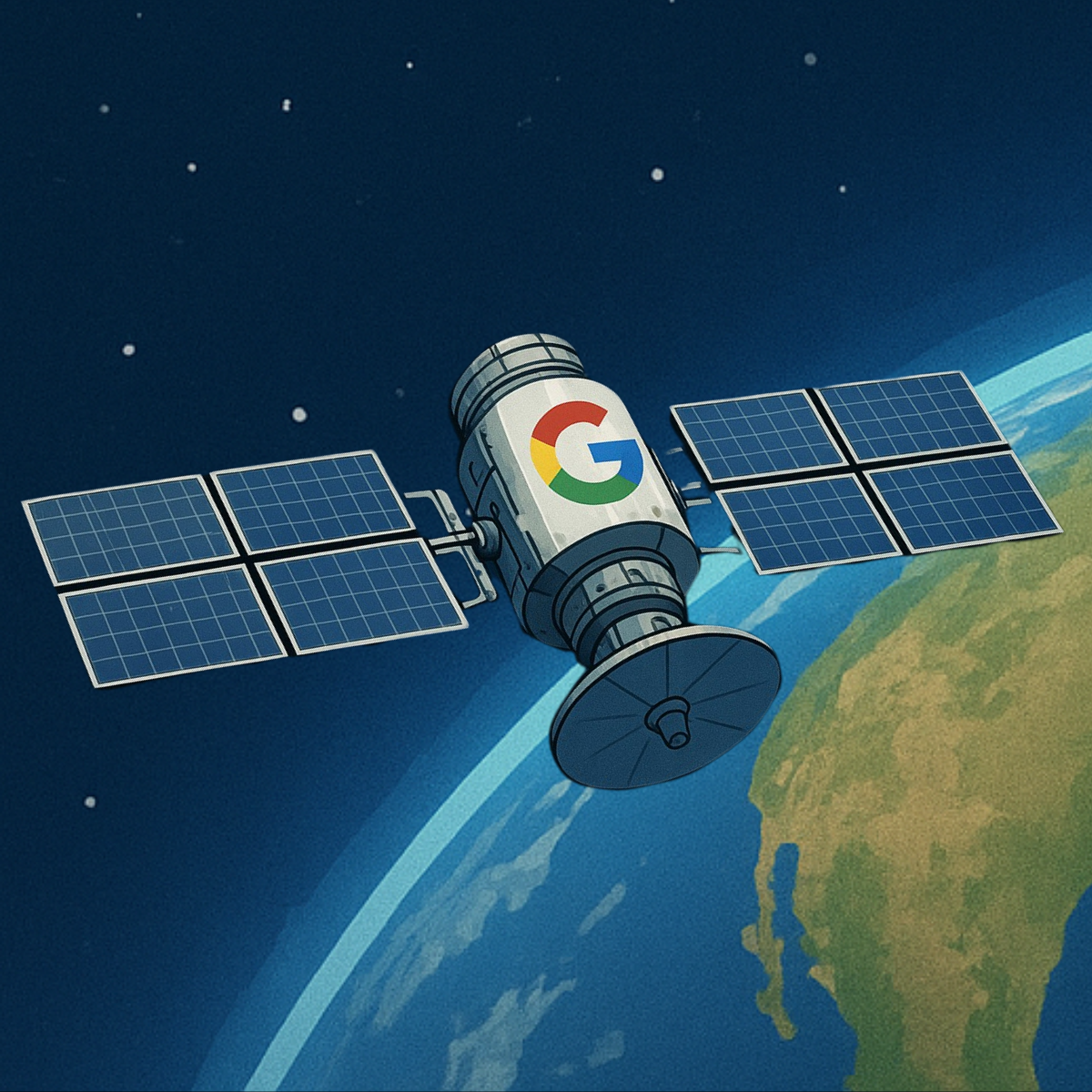
In an era defined by artificial intelligence and massive data consumption, Google is now looking toward the stars—literally. The company has reportedly begun developing concepts for AI data centres housed in space, powered entirely by solar energy harvested through advanced satellite technology. If realised, this project could redefine what “cloud computing” means, not just as a metaphor, but as a physical truth.
The Vision of Space-Based AI Infrastructure
Google’s proposed plan aims to solve the mounting problem of energy consumption on Earth-based data centres. Artificial intelligence systems like Gemini, DeepMind models, and global cloud operations require immense processing power and cooling systems. These centres consume terawatt-hours of energy annually, much of it sourced from fossil fuels or land-intensive solar farms.
By transitioning operations beyond Earth’s atmosphere, Google intends to tap into the abundant and uninterrupted energy of the sun. Solar-powered satellites operating in low-Earth orbit could collect continuous sunlight, providing a clean and steady power source. The generated energy would fuel onboard computational arrays—essentially floating data centres that manage and process complex AI tasks.
The concept isn’t new in science fiction, but its technological feasibility is only now coming within reach. SpaceX’s Starlink network demonstrated that interconnected, low-Earth-orbit satellites can handle intense data transfer loads. Google seems ready to take the next logical step: not just relaying information through space, but processing it there.
Energy Innovation: A New Age of Power Efficiency
Power efficiency is the driving factor behind this ambitious move. On Earth, data centres face physical limitations such as land scarcity, cooling requirements, and local energy costs. In contrast, solar power in orbit experiences neither weather fluctuations nor nighttime interruptions. A satellite array would enjoy nearly 99 per cent solar exposure, drastically improving efficiency.
Moreover, the vacuum of space can aid passive cooling. While designing thermal control systems remains complex, radiation-based cooling can be engineered to dissipate heat directly into space, eliminating the dependency on water cooling systems. This alone could save billions of litres of water annually, an increasingly valuable sustainability milestone.
Google’s sustainability pledge—to power all operations with renewable energy by 2030—could find its most dramatic expression in this space-based architecture. If successful, this model might inspire a new paradigm where digital infrastructure grows upward rather than outward.
Overcoming the Challenges of Computing Beyond Earth
Building AI data centres in orbit is not without enormous challenges. The foremost issue lies in hardware resilience. Cosmic radiation can corrupt memory, damage processors, and degrade semiconductors faster than terrestrial environments. Google’s engineers, likely collaborating with aerospace partners such as NASA or private launch firms, will need to develop radiation-hardened computing systems capable of consistent long-term operation.
Another challenge is latency—the time taken for data to travel between Earth and orbit. Even in low-Earth orbit, delays can reach tens of milliseconds, which may affect real-time AI applications like voice assistants or autonomous vehicle processing. To mitigate this, Google could design a hybrid system where space-based centres handle high-intensity model training while Earth-based centres manage immediate user interactions.
In addition, launch costs and orbital debris management remain critical considerations. Each satellite would require secure positioning, servicing protocols, and eventual deorbiting plans to comply with space sustainability guidelines.
The Broader Implications for the AI Ecosystem
If Google’s plan succeeds, it could establish an entirely new infrastructure layer for global AI. Instead of massive terrestrial data farms concentrated in certain countries, AI computing could be distributed into orbital clusters accessible from any region. This architecture could enhance data sovereignty, energy independence, and computational availability for developing nations.
Tech analysts also point to potential synergies with astrophysics and planetary observation. Since these satellites will feature powerful sensors and computational nodes, they might support dual-use missions—conducting both AI computing and space research simultaneously. Such multi-purpose infrastructures could redefine how commercial and scientific organisations cooperate in orbit.
Beyond the environmental and economic aspects, this project underscores humanity’s shift from Earth-bound technology management to an interplanetary mindset. As AI systems evolve toward general intelligence, placing their computational “brains” in space might serve as both symbolic and practical preparation for future exploration beyond Earth.
A Step Closer to a Cosmic Internet
Google’s move fits a broader trend among technology giants exploring decentralisation and sustainability. Microsoft and Amazon are testing underwater and modular data centres for efficiency gains, while Google’s space initiative adds a cosmic layer to this evolution. If solar-powered satellites can host AI workloads effectively, it may herald the rise of a genuine “cosmic internet”—a distributed network spanning both Earth and near space.
The vision remains in its early conceptual stages, but its implications cannot be overstated. By merging clean energy harvesting with extraterrestrial infrastructure, Google may not only redefine the future of cloud computing but also reshape humanity’s environmental footprint. In the decades ahead, the term “Google Cloud” might refer to something far more literal: gleaming satellites orbiting silently above, running AI models powered by the endless light of the sun.