Table of Contents
The world of technology is moving and growing at a fast pace. To list a few examples, companies need highly efficient computer systems to process business processes daily. Moreover, they do everything in their power, very often beyond additional external resources, to be relevant in the fast development of technology. Therefore, RAM shall not be an exception when the old and used becomes the efficient and overperforming type of RAM. The most unfortunate part of the described situation is that most IT managers do not know the critical value of the RAM the company has. Understanding the value price of RAM is critical for profit, saving money, and consumption of the IT asset.
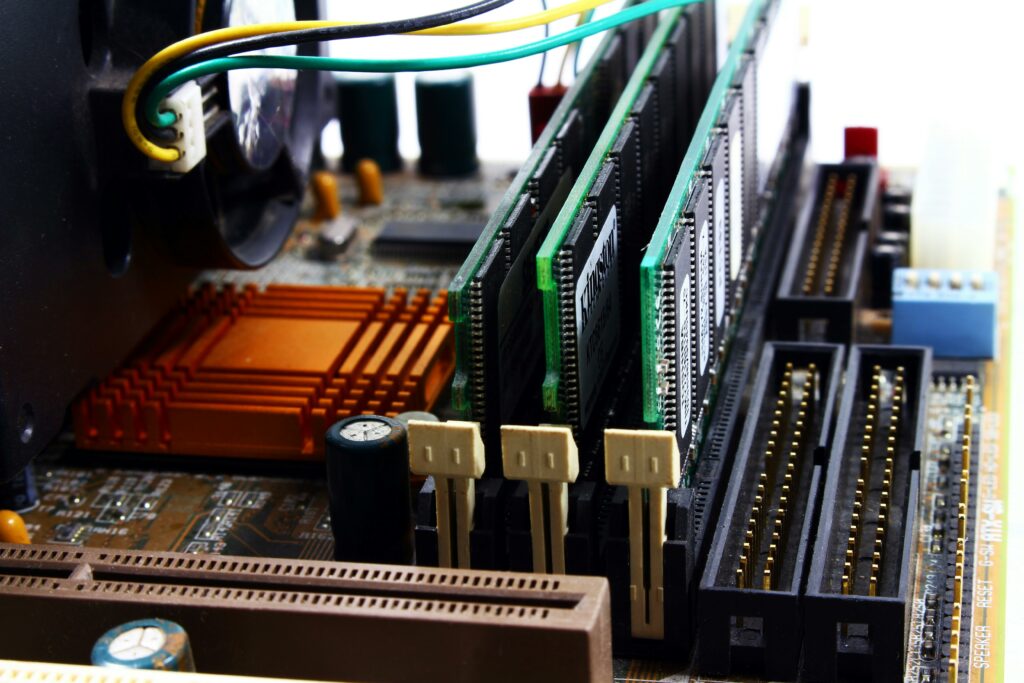
Image source: https://www.pexels.com/photo/black-and-gray-computer-motherboard-2588757/
The Importance of Properly Managing and Selling Used RAM Memory
Thus, properly managing and selling used RAM is not just about cleaning up space for obsolete equipment or recycling outdated equipment. For most companies, it is a realistic means of recovering a large part of the costs involved and reducing the net expenses of system improvement. Selling such memory items properly also relieves a source of funding for Fresco that might be rerouted to new technology or other parts of the business.
In addition, responsible IT asset management should account for the destructive environmental implications of e-waste. A company discovering a buyer for its used RAM modules and being interested in purchasing the goods for its use might even contribute to a circular economy. In circular economics, essential chemicals and materials are utilized indefinitely instead of being dumped into a du. When a company sells used RAM appropriately, it enhances its financial performance while also pursuing more responsible IT.
The determination of the value of used RAM
For IT managers to accurately sell used processor chips, they must understand several factors. Multiple considerations are used to Judge the value of user RAM modules, including the type of registered and unregistered used RAM chips, specifications for example, 240-pin DDR2 SDRAM, how long the structures have been used, under which conditions the structure has been maintained, market demand based on these products, and used RAM modules. Here are some of the factors:
When it comes to the classification and specifications of RAM chips, the value differs. Generation & kind of RAMs The secondary market of DDR3 vs DDR 4 or ECC (Error-Correcting Code) RAMs have dissimilar worth on the secondary market. Additionally, RAM modules of greater capacity and faster ‘speeds’ are in greater demand than slower RAM modules, and consequently, they are even more expensive.’ The age of the product Memory age also dramatically influences the value of the merchandise. For instance, newer RAM versions are given more weight than older RAM versions and extremely used merchandise.
Furthermore, the relations and credibility of the merchandise may even be valued more if it’s in excellent and undamaged packages or the warranty phase is yet to start. Market appeal and demand: Market demand and desirability are the remaining factors that affect price. The impacts of the supply and demand cycle can shift since the concept of redress dictates the value. The producers expect the supply and demand cycle to alter based on technological advancements, business trends, and scarcity or profusion of RAM.
Furthermore, you understand the performance and willingness of the market when you understand what the corporation’s products might be worth somewhere. Several ways help to determine the value of used RAM. These are online marketplaces and auction sites that provide actual market value based on existing listings and completed sales.
In the same way, existing pricing tools and calculators accessed via the World Wide Web provide some of the current data using factors such as the type, capacity, and state of media.
Although the offered values can vary slightly from the exact market value, it provides a good measure to begin estimating how much this product will fetch. Similarly, one is strongly advised to consider consulting IT hardware vendors and other qualified professionals experienced in valuing IT equipment since they can give the most accurate price due to their expertise in the field and awareness of the current market.
Suffering Minimal Data Security Risks
It’s so vital not to suffer any data security risks while wanting to sell used RAMs. The point is that when power is turned off, RAM is a “volatile” memory, and the information stored there is lost. However, a second ago, residual data may remain disconnected from the circuit RAM in a computer system. To ensure no sensitive or confidential information, IT managers must delete the data in ROM when they want to sell or dispose of their RAM semiconductors.
Various software utilities enable you to erase all the data stored on the RAM chips securely. Without a single trace of confidential or private information, you can worry little about using these, too.
Finally, ITADs dispose of obsolete equipment in an environmentally responsible way only when the data has been deleted. Well-regarded ITADs provide secure recycling and disposal facilities that treat RAM modules based on valid policies. A dedicated SHVC-certified asset disposal company must be chosen to ensure that RAM modules enjoy the benefits of responsible and sustainable disposal.
The Pros and Cons of Selling Used RAM Memory
Any business decision, including selling used RAM, has advantages and disadvantages. To help IT managers, one should consider the possible factors regarding the sale of their company’s used RAM.
On the one hand, selling used RAM allows IT managers to recover some of the initial price. This psychological and financial value can be reinvested in purchasing even more modern technology or spent on another business direction.
This responsible IT asset management also reduces electronic waste and supports the circular economy.
However, there are also some cons. For example, selling used RAM modules may expose sensitive company or client data when not thoroughly cleaned. In this regard, the data must be deleted from the used RAM before discarding it to sell it and reduce the risk of a data breach. Secondly, the fluctuating market demand for RAM and price can make future sales impossible.
Find Suitable ITAD Companies
When considering selling a used RAM, one must find a suitable IT asset disposal company (ITAD). ITAD companies focus on scrubbing off and remarketing old IT stuff, including RAM modules. They are well-suited service providers to IT professionals who want to securely and environmentally scrap used RAMs.
The ITAD company needs to research a secure and prosperous sales process. One should vet and inspect the company, with priorities being its reputation cooperatively, experience and profession, environmental regulation compliance, data sanitation procedures, and qualifications concerning the organization. It is an assurance of a good and safe selling process to find an ITAD company recommendation according to the company’s reputation and needs.
Price and Terms Negotiations.
Before hiring an ITAD company’s services, IT managers need to compile and price an inventory of the RAM modules. As the inventory is compiled, it should describe the types of RAM, the amount, and the state of the products. The price allows IT managers to negotiate fairly with the ITAD company.
Furthermore, IT managers need to research the value of RAM “in the market” and its future market. One can research this through online exchanges, web pricing tools, and advice from IT hardware resellers at any given time and analyze the data over weeks or months. Buying RAM modules is a commodity, and when they know where to direct the funds due to the item’s value, they can negotiate with the ITAD company.
Selling Used RAM Memory to ITAD Companies
Selling used RAM to IT companies has many advantages for IT managers. Firstly, ITAD businesses holistically address RAM’s disposal. This means that the RAM modules used are disposed of correctly and according to environmentally sustainable industry standards.
Second, ITAD businesses specialize in equipment resale. This usually ensures that the IT manager’s RAM selling chances are optimized by partnering with ITAD companies due to the ITAD company’s market-wide network. ITAD companies also have market experience and a detailed understanding of IT equipment markets; both factors facilitate the RAM selling process, possibly earning the IT manager more income.
Finally, ITAD companies enable viable continuation and reuse of used RAM modules, which can be found in other computer machine applications.
Conclusion
Using RAM value, IT managers can save money, get cash, and dispose of their IT assets correctly. Moreover, the types of RAM, their specs, duration, market conditions, and other variables prescribe some RAM values and reduce some uncertainty. Similarly, one must use pricing approaches for market value calculation, such as online marketplaces, pricing tools, and IT hardware resellers’ consultations, to create a complete market image. To make the right selling decisions, the manager must also reduce the factor of data security breaches, use a reputable ITAD company, and provide a trustworthy, safe final price and term. Using RAM value – the company benefits from obtaining cash and saving the environment and the company’s name or credit side.