Table of Contents
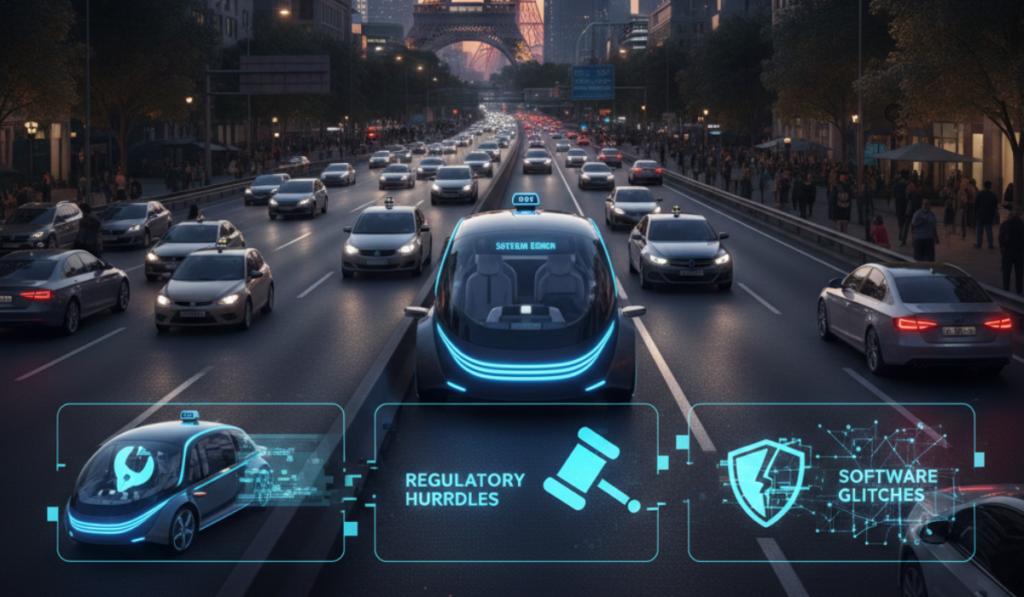
The world is on the verge of a major transportation revolution, led by self driving taxis — autonomous vehicles designed to reshape how we think about mobility, urban infrastructure, and sustainability. From San Francisco to Shanghai and now spreading across Europe, the driverless self driving taxi industry is gaining speed, promising safer roads and more efficient commutes. Yet, as this futuristic dream accelerates toward reality, it continues to face technological, regulatory, and social challenges that keep it from achieving full autonomy.
In this blog, we’ll explore how self driving taxis are expanding globally, what’s fueling their growth, and why the dream of a completely autonomous world still encounters bumps on the road.
The Rise of Self Driving Taxis: A Global Trend
The story of self driving taxis begins with the long-standing quest for safer, smarter, and more sustainable transportation. The idea isn’t new. Decades of innovation in
artificial intelligence, sensors, and automation laid the foundation for vehicles that could one day drive themselves.
Fast forward to today, and the world is witnessing pilot programs and commercial driverless self driving taxi services operating in countries like the United States, China, Japan, Germany, and the United Arab Emirates.
Companies like Waymo, Cruise, and Motional are leading the charge in America, with fleets of self driving taxis operating in major cities such as San Francisco, Phoenix, and Austin. Meanwhile, Baidu’s Apollo Go and Pony.ai have made impressive strides across Chinese cities, demonstrating that Asia is equally invested in autonomous taxi ecosystems. Even Europe has started to join the race, with Germany and the UK running public trials supported by progressive government policies.
What’s making these global launches possible is a mix of technological advancements — from sensing and AI to 5G connectivity and high-definition mapping. Together, they allow self driving taxis to perceive and react to their surroundings almost like humans do.
The Technology Powering Self Driving Taxis
At the heart of every self driving taxi lies a sophisticated combination of sensors, algorithms, and computing systems that enable autonomous mobility. These vehicles rely on:
- LiDAR sensors (Light Detection and Ranging) to create detailed 3D maps of their environment.
- Cameras that identify pedestrians, other vehicles, and traffic signals.
- Radar systems that measure distances accurately, even in rain or fog.
- High-performance onboard computers processing data in real time to make safe driving decisions.
AI-based neural networks further enhance these systems by learning from millions of driving hours. They help driverless self driving taxis handle real-world conditions — from avoiding jaywalkers to merging on busy highways. 5G connectivity adds another layer by enabling real-time communication between vehicles and central control systems, improving efficiency and safety.
Despite these innovations, achieving Level 5 autonomy — where self-driving taxis operate independently without any human input, anywhere, anytime — remains one of the biggest challenges. Most services today function at Level 4, limited to mapped cities or designated operating zones.
Why the Self Driving Taxi Dream Still Hits Bumps
While progress is undeniable, several obstacles still slow down the widespread adoption of self driving taxis:
- Regulatory confusion: Different regions have inconsistent laws about autonomous vehicle testing and operation.
- Safety concerns: Accidents involving test robotaxis raise public skepticism.
- Cost of technology: High sensor and computing costs make commercial scalability tough.
- Public trust: Many passengers remain uneasy about riding in a vehicle without a human driver.
However, every challenge also sparks innovation. As AI, data processing, and global collaboration advance, the goal of bringing self driving taxis to every major city becomes more achievable — one road test at a time.
Expansion Around the World
The global Driverless Robotaxis movement is not happening in isolation. Each region’s development reflects unique motivations, regulations, and infrastructure realities.
1. The United States:
Waymo, owned by Alphabet, operates one of the most advanced robotaxi fleets in Phoenix and San Francisco, allowing fully driverless rides to the public. Cruise, a subsidiary of General Motors, is also expanding aggressively, though it faced major setbacks with regulatory scrutiny after incidents involving pedestrian safety. Despite challenges, U.S. cities remain testing grounds for large-scale robotaxi deployment.
2. China:
China is a giant in the making for Driverless Robotaxis. Companies like Baidu and Pony.ai operate thousands of rides weekly, with government support accelerating the rollout. The country’s dense urban centers and strong manufacturing ecosystem give it an edge in scaling this technology faster than most Western nations.
3. Europe and the Middle East:
Europe’s regulatory environment is cautious but progressive. Nations like the UK, Germany, and France are slowly expanding autonomous vehicle trials, focusing heavily on safety and public acceptance. Meanwhile, Dubai aims to have 25% of all trips powered by autonomous vehicles by 2030, showcasing ambitious Middle Eastern investment in smart mobility.
The Promise of Driverless Robotaxis
Advocates envision Driverless Robotaxis as a transformative force for modern cities. The benefits are numerous and compelling:
- Reduced road accidents: Human error accounts for over 90% of traffic collisions. Robotaxis can overcome fatigue, distraction, and impaired judgment.
- Lower congestion and emissions: Optimized routes and shared mobility models could cut urban traffic and carbon output significantly.
- Accessibility for all: Autonomous taxis offer mobility solutions to the elderly, people with disabilities, and those without driver’s licenses.
- 24/7 availability: Unlike human drivers, robotaxis can operate continuously, improving fleet utilization and overall reliability.
Cities struggling with congestion, pollution, and infrastructure strain see autonomous ride-hailing as a viable path toward smarter and greener transportation networks.
Obstacles on the Road: Technical and Ethical Challenges
Despite its promise, the Driverless Robotaxi industry still hits significant bumps. Real-world traffic is unpredictable — from poorly marked roads to pedestrians behaving unexpectedly. AI models struggle with these “edge cases,” which makes ensuring absolute safety extremely difficult.
Key challenges include:
- Complex urban environments: Variable weather, construction zones, and aggressive human drivers test the limits of AI perception.
- High production costs: Developing and maintaining sophisticated sensors and computing systems is expensive, making profitability elusive.
- Public skepticism: Incidents involving malfunctions or injuries quickly erode trust in autonomous systems.
- Legal and ethical dilemmas: Determining liability in case of accidents remains unresolved in many countries. Who’s at fault — the manufacturer, the developer, or the operator?
Moreover, the transition to autonomy raises bigger societal questions. Will robotaxis displace millions of drivers globally? What happens to automotive insurance and urban planning as human-driven cars fade?
Regulatory and Policy Roadblocks
The regulation of Driverless Robotaxis varies widely across the globe. In the United States, each state has its own rules, creating a patchwork of compliance requirements. Europe’s stricter safety standards often slow down testing, while China’s centralized approval process helps it move faster but under government control.
Some forward-thinking cities like Singapore and Dubai are implementing regulatory sandboxes, allowing real-world autonomous testing under supervision. This balanced approach encourages innovation while managing public risk.
However, the absence of global standards remains a hurdle. Until universal frameworks are agreed upon — covering data privacy, accident reporting, and ethical behavior for AI — robotaxis will face limitations in scaling internationally.
Economic Impact and Future Market Forecast
Experts predict the global Driverless Robotaxis market will exceed USD 150 billion by 2035, driven by rising demand for shared mobility and decreasing vehicle ownership trends. As AI systems improve and sensor costs drop, the per-mile cost of autonomous rides could undercut traditional taxis and even personal vehicles.
For automakers, tech giants, and startups, robotaxis represent the next frontier of competition. Traditional automakers such as Toyota and Hyundai are shifting focus to autonomous vehicle platforms, while technology giants like Amazon and Apple pursue secretive R&D in self-driving technology.
In addition to passenger transport, commercial applications such as autonomous delivery vans and logistics shuttles could multiply the impact across industries. Smart city planners envision fleets of connected vehicles reducing emissions, optimizing traffic, and freeing up land currently devoted to parking.
The Human Factor: Trust and Acceptance
Perhaps the biggest obstacle to Driverless Robotaxis isn’t technology — it’s trust. Many people remain wary of surrendering control to machines, especially when headlines highlight accidents involving autonomous vehicles. Building acceptance requires transparency, education, and gradual introduction, starting with mixed-use zones and supervised pilots.
Surveys show that younger urban populations are more open to trying robotaxis, while older demographics prefer human-driven transportation. Public confidence will likely grow as safety records improve and the technology becomes more familiar.
The Road Ahead for Driverless Robotaxis
The global journey of Driverless Robotaxis is a thrilling yet uneven ride. The technology is no longer a distant dream — it’s operating on city streets today. However, the full vision of effortless, universally available autonomous mobility still faces challenges in regulation, cost, and public trust.
Over the next decade, we can expect hybrid systems where human oversight and AI co-exist, gradually transitioning to fully automated operation. Collaborations between automakers, governments, and tech firms will define how fast and efficiently this transition happens.
Ultimately, Driverless Robotaxis embody both the promise and complexity of progress. They stand at the intersection of innovation, ethics, and economics — a reflection of society’s struggle to balance technological ambition with human responsibility. As the road to autonomy unfolds, one truth remains: the dream is alive, but the world must steer carefully to make it real.