Table of Contents
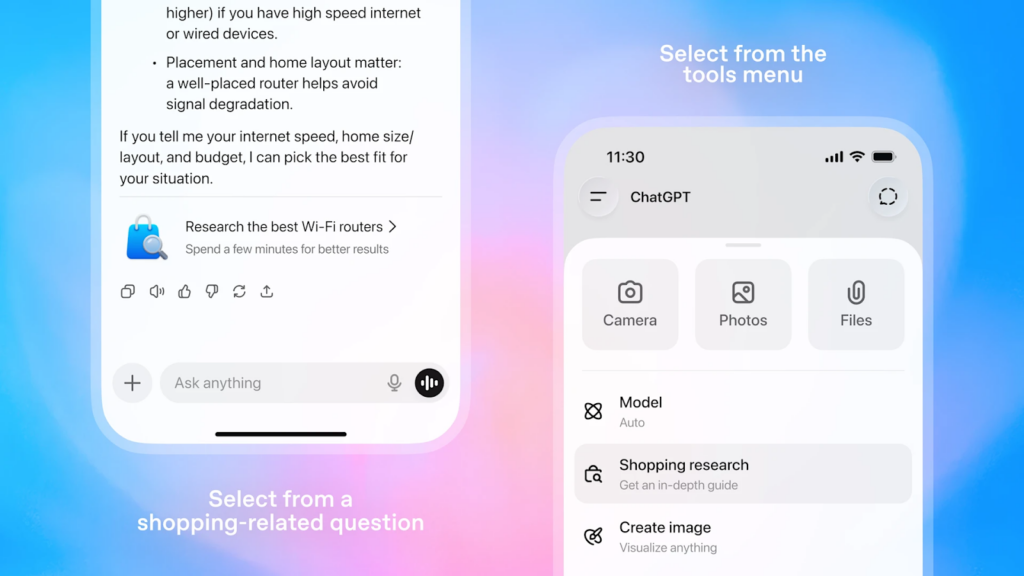
ChatGPT’s shopping feature enables users to discover, compare, and purchase products directly within conversations using Instant Checkout powered by the Agentic Commerce Protocol with Stripe. Available to free, Plus, and Pro users in the U.S., it starts with Etsy sellers and expands to over a million Shopify merchants like Glossier and SKIMS. This seamless integration marks a shift toward agentic commerce, where AI acts as a personal shopper without leaving the chat interface.
Instant Checkout Mechanics
Users query ChatGPT with natural language prompts like “best running shoes under $100,” receiving organic, unsponsored product carousels ranked by relevance, complete with images, ratings, prices, and reviews from real-time web data. A “Buy” button appears for supported items, leading to a secure checkout where subscribers use saved cards, Apple Pay, or Google Pay to confirm orders in taps. Merchants handle fulfilment via existing systems, paying a small fee while retaining customer relationships; ChatGPT shares minimal data with user consent.
ChatGPT vs. Comet: Feature Comparison
Perplexity’s Comet, an AI-powered browser launched in July 2025, offers agentic shopping by automating tasks like review summaries, price comparisons across sites, and cart additions on platforms like Amazon or Instacart. Unlike ChatGPT’s chat-based flow, Comet integrates assistance into browsing, handling multi-tab workflows and real-time actions but facing restrictions like Amazon’s cease-and-desist over terms violations. The table below compares core aspects:

ChatGPT excels in simplicity for direct purchases, while Comet shines in research-heavy sessions.
Why Adopt ChatGPT’s Shopping Feature
This feature addresses modern shopping pain points like tab overload and decision fatigue by consolidating discovery to purchase in one interface, saving time for busy users. It personalises recommendations from past interactions without sponsored bias, fostering trust through transparent, relevance-based ranking. For merchants, the open Agentic Commerce Protocol enables quick integration—one line of code for Stripe users—expanding reach to ChatGPT’s 700 million weekly users while preserving control. Amid rising e-commerce competition, it challenges traditional search ads by prioritising user experience over revenue.
Future Implications
Expansions include multi-item carts, global regions, and deeper agentic capabilities, positioning ChatGPT as a commerce hub. Compared to Comet’s browser focus, ChatGPT’s protocol invites broader AI ecosystem adoption, potentially standardising agent-merchant interactions. Users benefit from evolving personalisation, like preference-based suggestions, transforming AI from assistant to transactional partner.
ChatGPT’s shopping feature represents a pivotal evolution in how everyday users interact with commerce through AI. By embedding e-commerce functionality directly into conversational flows, OpenAI eliminates the traditional divide between product research and purchase decisions. This approach exemplifies agentic commerce—a model where the AI not only retrieves information but acts on behalf of users to complete transactions in context, all without requiring manual navigation through multiple websites or applications.
Technology and Infrastructure
Under the hood, ChatGPT’s shopping capability relies on the Agentic Commerce Protocol, a standardized system built to ensure secure data exchange between AI agents, payment processors, and merchant platforms. This protocol uses Stripe as the transactional backbone, integrating secure payment routing, tokenized authentication, and minimal data sharing principles. For users, payment credentials remain encrypted, and merchants receive only necessary fulfillment details. This layered model balances convenience with privacy, avoiding the “data handoff” common in traditional ad-driven commerce ecosystems.
OpenAI’s collaboration with Etsy and Shopify sellers ensures scalability and authenticity in product discovery. Each listing in the shopping carousel is synced from verified real-time merchant feeds. Product visibility is determined by contextual relevance and query alignment rather than paid placement, positioning ChatGPT as a fair discovery engine rather than an advertising platform. The reliance on organic ranking counters the “search ad fatigue” prevalent on marketplaces like Google Shopping or Amazon.
Developer and Merchant Integration
The system’s open integration offers significant opportunities for small and mid-sized merchants. With only a few lines of code connecting through Stripe’s API, sellers can list eligible products within ChatGPT’s marketplace instantly. This democratizes access, lowering entry barriers for independent creators. Additionally, OpenAI’s documentation suggests that future updates may enable inventory synchronization across multiple platforms, linking Shopify, WooCommerce, and BigCommerce into a unified conversational storefront accessible from within ChatGPT.
From a developer’s standpoint, the Agentic Commerce Protocol could evolve into a new standard for AI-to-commerce interoperability, enabling other AI systems—including third-party assistants—to securely perform transactions across participants in the ecosystem. This protocolization of commerce could mirror how OAuth standardized authentication across the web.
Market and Consumer Impacts
Economically, ChatGPT’s shopping integration challenges Google’s dominance in product discovery and Amazon’s grip on fulfillment-centric retail. Unlike traditional search results flooded with sponsored listings, ChatGPT’s model prioritizes trust and personalization. By leveraging historical chat data—such as user style preferences, sizes, or past purchases—the AI can refine future shopping recommendations, bridging the gap between discovery and loyalty. It effectively transforms the AI assistant into a personal buyer capable of understanding context, taste, and intent.
For consumers, the result is a frictionless, single-interface shopping experience free from tab overload and cognitive fatigue. For merchants, it opens a non-advertising-driven discovery pipeline with direct access to 700 million weekly users. Combined with expanding features like multi-item carts and region-specific support, this initiative positions ChatGPT at the forefront of agentic commerce—a territory where traditional search, marketplace, and ad models converge under AI mediation.
In contrast, Comet continues to push the boundary of AI-enhanced browsing, empowering users who prefer hands-on research and control. Yet, ChatGPT’s streamlined, chat-based purchases highlight a different kind of efficiency: one rooted in personalization, conversation, and trust. As both ecosystems mature, users will likely shift fluidly between them—browsing with Comet for exploration and buying through ChatGPT for convenience—signaling the rise of a new, AI-mediated commercial web.