

Table of Contents

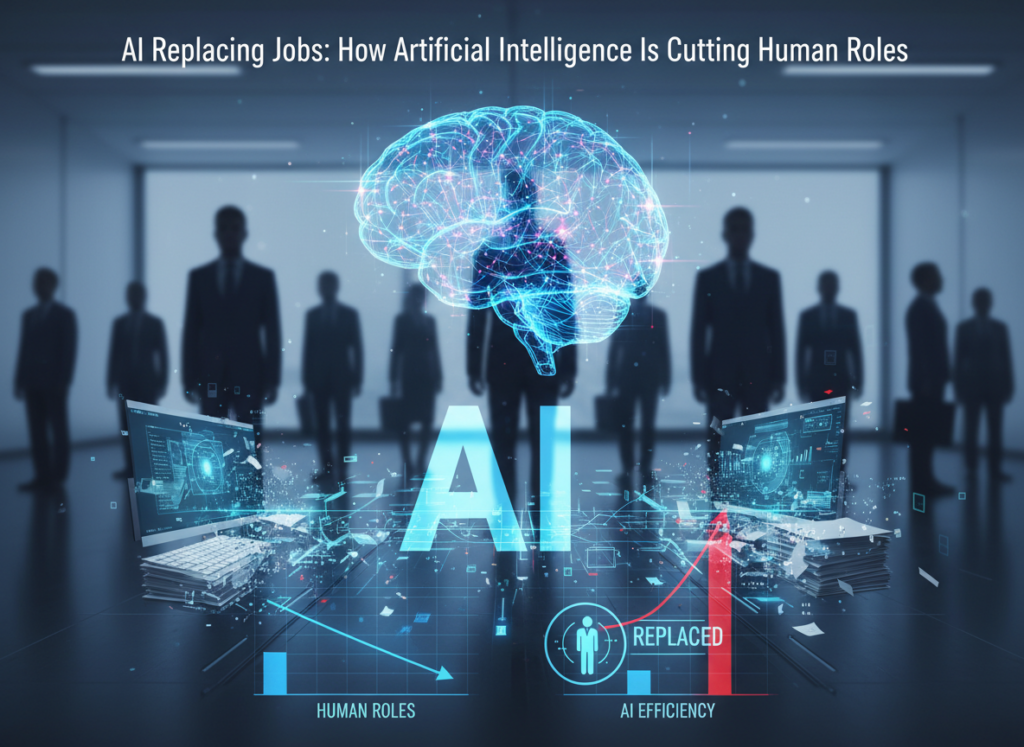
AI Replacing Jobs
Artificial Intelligence is no longer something we only imagined in science fiction. It is actively transforming industries, automating routine tasks, and reshaping the structure of the global workforce.
From AI-powered chatbots handling customer support to intelligent systems managing investment portfolios, technology is steadily decreasing reliance on human labor across multiple sectors.
But how quickly is this transformation happening? And what could employment look like by 2030?
Let’s take a closer look.
The Expansion of AI in the Modern Workplace
The release of advanced AI tools like ChatGPT significantly increased public awareness about how capable intelligent systems have become. Meanwhile, major corporations such as Tesla and Amazon continue investing billions into robotics, automation, and AI-driven logistics.
Today, Artificial Intelligence systems can:
- Generate written content
- Create graphic designs
- Operate autonomous vehicles
- Review legal documents
- Assist in medical diagnostics
- Manage warehouse operations
- Conduct customer service interactions
While these technologies improve productivity and lower operational costs, they also reduce demand for certain traditional job roles.
Industries Experiencing the Biggest Impact
Several sectors are already seeing noticeable workforce changes due to automation.
| Industry | AI Usage | Jobs Most Affected | Impact Level |
| Customer Support | Chatbots & Virtual Assistants | Call center representatives | High |
| Manufacturing | Industrial robotics | Factory workers | High |
| Transportation | Autonomous driving systems | Delivery & truck drivers | Medium–High |
| Retail | Self-checkout & smart inventory | Cashiers | Medium |
| Creative Services | AI writing & design tools | Entry-level creators | Medium |
| Financial Services | Automated trading systems | Junior analysts | Medium |
Why Businesses Are Turning to AI
Organizations adopt Artificial Intelligence for several strategic reasons:
1. Lower Operational Costs
- No wages or employee benefits
- No absenteeism
- Continuous 24/7 operation
2. Faster Performance
Artificial Intelligence systems can process and interpret enormous volumes of data within just a few seconds.
3. Improved Accuracy
Automation reduces errors in repetitive and rule-based tasks.
4. Easy Scaling
Digital systems can expand globally without major increases in overhead.
Roles Most Vulnerable by 2030
If current trends continue, these jobs face the highest automation risk:
- Telemarketing positions
- Data entry operators
- Retail cashiers
- Basic support representatives
- Accounting clerks
- Warehouse fulfillment workers
- Entry-level designers
- Transcription professionals
Careers Expected to Grow
Although automation removes some roles, it also generates new opportunities.
| Emerging Role | Why Demand Will Increase |
| AI Developers | Building and improving AI systems |
| Data Analysts & Scientists | Interpreting complex datasets |
| Cybersecurity Specialists | Protecting digital infrastructure |
| AI Policy & Ethics Advisors | Governing responsible AI use |
| Human-AI Workflow Managers | Integrating AI into operations |
| Robotics Technicians | Maintaining automated systems |
Why the Transition Isn’t Instant
Despite rapid progress, Artificial Intelligence is not replacing humans overnight. Several factors slow the shift:
- Artificial Intelligence systems still require human monitoring
- Emotional intelligence remains uniquely human
- Legal and regulatory frameworks limit rapid deployment
- Smaller companies may lack automation budgets
This makes the transformation gradual rather than sudden.
Employment Predictions for 2030
Looking ahead, several major changes are likely:
1. Blended Work Environments
Humans working alongside Artificial Intelligence tools will become standard practice.
2. Skill Imbalance
High-level technical skills will become more valuable, while repetitive low-skill jobs may decline.
3. Wage Gap Expansion
Highly skilled professionals may see income growth, widening economic inequality.
4. Continuous Reskilling
Workers may need to update their skills every few years to stay competitive.
5. Policy Changes
Governments may introduce measures such as:
- Universal Basic Income (UBI)
- Automation-related taxes
- National retraining initiatives
Global Outlook Toward 2030
| Region | AI Adoption | Risk of Job Disruption |
| North America | Very High | High |
| Europe | High | Medium–High |
| Asia | Very High | High |
| Africa | Moderate | Low–Medium |
| South America | Moderate | Medium |
What Humans Still Do Better
Even as automation advances, humans maintain advantages in:
- Emotional creativity
- Complex leadership decisions
- Moral reasoning
- Care-based professions (healthcare, therapy, education)
- Strategic thinking during uncertainty
Is AI a Threat or an Opportunity?
Whether AI becomes a threat depends largely on preparation and adaptability.
Technology does not simply eliminate work — it transforms it. Past industrial revolutions replaced certain jobs but created entirely new industries in the process. AI appears to be following a similar path, though at a faster pace.
How to Stay Relevant in the AI Era
To remain competitive by 2030:
- Learn how to use AI tools effectively
- Strengthen analytical and problem-solving skills
- Develop creativity and communication abilities
- Improve digital literacy
- Commit to lifelong learning
Conclusion
Artificial Intelligence will continue automating predictable and repetitive tasks. By 2030, many traditional roles may decline — but new career paths will also emerge.
The greatest danger is not artificial intelligence itself.
The real challenge is failing to evolve with it.
The future workplace will not be humans competing against AI.
It will be humans working alongside AI.