Table of Contents
User Experience (UX) design has always been about understanding people—how they interact with digital products, how they behave online, and what frustrates or delights them. In today’s digital-first world, however, user behaviours change rapidly, and businesses must adapt just as fast. This is where Artificial Intelligence (AI) steps in.
AI is not replacing UX designers, but it is giving them powerful new tools to create, test, and refine user interfaces (UI) more effectively. From automating usability testing to generating design variations, AI is reshaping how digital experiences are built.
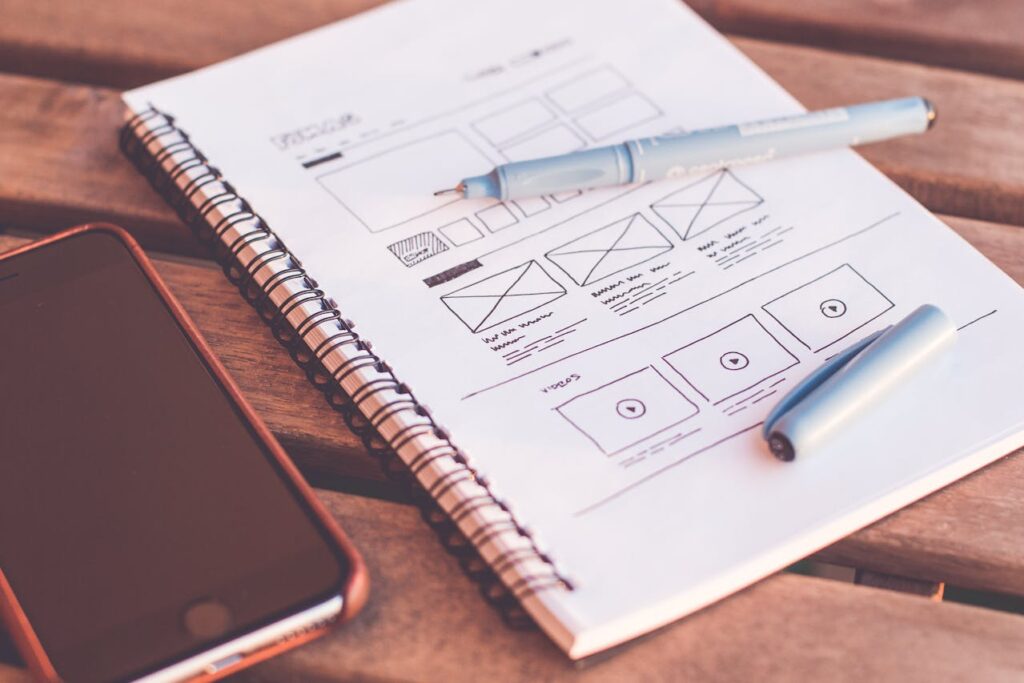
Image source: https://www.pexels.com/photo/notebook-beside-the-iphone-on-table-196644/
The Growing Role of AI in UX
The global UX design market is expanding rapidly. According to Grand View Research, the UX industry is projected to reach USD 20.58 billion by 2028. Much of this growth is fuelled by new technologies like AI, which allow designers to test ideas faster and at greater scale.
Expert commentary: Dr. Elizabeth Churchill, Director of UX at Google, has noted that AI tools “augment human creativity by accelerating repetitive tasks, leaving more room for designers to focus on empathy and innovation.”
How AI Helps in UX Design
Automated User Research
Traditional user research can take weeks of surveys, interviews, and usability testing. AI now accelerates this process by analysing user behaviour data in real time.
- Heatmaps and Eye Tracking: Tools like Hotjar and Crazy Egg use AI to simulate user interactions, showing where users click, scroll, or lose interest.
- Behaviour Prediction: Machine learning models predict what users are likely to do next—whether abandoning a checkout page or engaging with specific content.
- This gives designers early insights without needing dozens of in-person tests.
AI-Driven Wireframing and Prototyping
AI can also assist in the creative stage:
- Design Suggestions: Platforms like Figma with AI plugins and Uizard can auto-generate wireframes based on text prompts.
- Layout Optimisation: AI recommends best practices in alignment, spacing, and typography, reducing human error.
- In essence, AI is not designing for humans but co-designing with them.
How AI Transforms UX Testing
Usability Testing at Scale
AI allows remote usability testing across thousands of users simultaneously. Algorithms analyse clickstreams, session recordings, and error rates to identify friction points.
Example: The AI-driven platform UserTesting provides real-time feedback analysis, turning hours of video into actionable insights.
Sentiment Analysis
By analysing natural language from user feedback, AI detects emotions such as frustration, confusion, or satisfaction. This is particularly useful in customer support interfaces and apps where tone matters.
Expert commentary: Jared Spool, a leading UX researcher, explains: “AI enables us to understand not just what users do, but how they feel while doing it—something we could only guess at before.”
Predictive A/B Testing : Instead of waiting weeks for A/B testing results, AI can model user behaviour and predict outcomes of design changes. This accelerates iteration cycles and reduces costs
AI and Personalised UX
Personalisation is one of the strongest areas where AI is impacting UX design. By learning from user interactions, AI systems customise digital interfaces for individual needs:
- E-commerce: Product recommendations tailored to browsing history.
- Content Platforms: News feeds or video suggestions optimised for user interests.
- Accessibility: Interfaces that adapt to users with disabilities, such as text-to-speech or colour contrast adjustments.
- Case Study: Netflix’s recommendation engine, powered by AI, is considered one of the most effective UX-driven algorithms, responsible for over 80% of content watched.
Practical Example: AI Meets Everyday UX
Even seemingly small UX tasks are influenced by AI. For example, generating secure and creative digital identities—such as usernames—has traditionally been a manual task. AI-powered tools like a username generator streamline this process, ensuring that users have simple, unique, and relevant identifiers that enhance onboarding experiences. This small detail highlights how AI improves both design efficiency and user satisfaction in subtle but meaningful ways.
Challenges of Using AI in UX Design
Despite its benefits, AI in UX also raises challenges:
- Bias in Algorithms: If training data lacks diversity, AI may generate designs or test outcomes that fail under real-world use.
- Over-Reliance on Automation: Designers risk losing human empathy if they rely too heavily on machine outputs.
- Data Privacy: Collecting and analysing user data for AI testing raises GDPR and ethical concerns, particularly in the EU and UK
- Expert commentary: Kat Holmes, Director of Inclusive Design at Microsoft, warns that “AI should be used to amplify inclusivity, not automate exclusion.”
Future of AI in UX
Looking ahead, AI in UX design will continue to expand:
- Generative UX: Entire user flows and navigation systems generated from simple prompts.
- Real-Time Adaptation: Interfaces that change instantly depending on user mood, detected through voice or facial recognition.
- Cross-Device Consistency: AI will ensure seamless experiences across VR, AR, mobile, and desktop platforms.
- According to Forrester Research, AI-driven UX improvements could raise customer satisfaction scores by 20% or more by 2030.
Conclusion
AI is not a replacement for UX designers but a powerful partner. It automates repetitive processes, analyses massive datasets, and enables personalisation at scale. For businesses, this means faster design cycles, better customer insights, and ultimately, more engaging user experiences.
For UX professionals, the challenge is to embrace AI thoughtfully—using it to enhance creativity and empathy rather than diminish them. As AI continues to evolve, the designers who learn to harness it responsibly will shape the future of digital interaction.