Table of Contents
What is Sora 2?
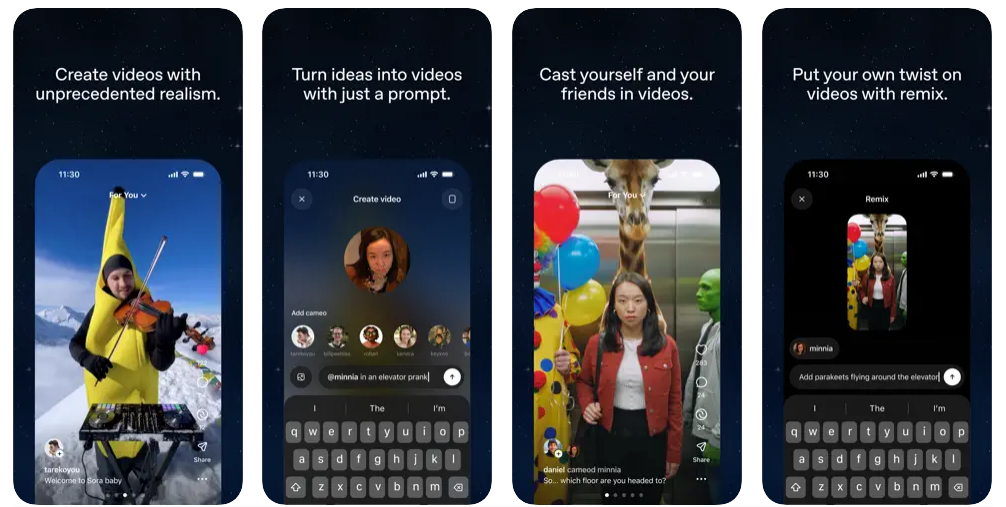
Sora 2 is OpenAI’s latest cutting-edge AI model that creates high-definition, realistic video clips with synchronized audio directly from simple text prompts. This next-generation tool extends the possibilities of AI-generated content, combining advanced physics, world simulation, and creative storytelling, and enabling users to generate complex visual sequences that look and feel real. Sora 2 powers a new social media app that lets users generate, remix, and share videos, marking a bold move toward AI-driven creative platforms.
Why Now?
The timing of Sora 2’s launch is crucial. Video content dominates online consumption and short-form video apps like TikTok and YouTube Shorts have exploded in popularity. AI video generation was previously limited by choppy motion or unrealistic output. OpenAI’s advances in deep learning, diffusion models, and transformers have finally converged to break through these barriers—making it possible to generate longer, more realistic, and more controllable videos than ever before. Sora 2’s debut not only responds to popular demand for improved creative tools but also races to outpace new rivals such as Google’s Veo 3 and Meta’s latest video initiatives.
From Whom?
Sora 2 is developed and launched by OpenAI, the San Francisco-based research company known for major AI breakthroughs like GPT series, DALL-E, and the original Sora model. OpenAI’s mission is to ensure that powerful artificial intelligence delivers broad public benefit—Sora 2 is its latest step in making advanced creative tools accessible beyond technical experts.
Advantages
- Stunning Realism: Generates videos with accurate physics—movements, collisions, light, and sound match real-world logic.
- Synchronized Audio: Capable of producing not just videos but natural speech, background noise, and effects that match the visuals.
- Multimodal Creativity: Handles a wide range of visual styles (cinematic, realistic, anime) and can integrate real-world elements, including personalized “cameos.”
- Controllability: Allows users and professionals to maintain style, continuity, and object consistency across multiple shots or evolving scenarios.
- Efficiency & Accessibility: Democratizes complex video creation for non-experts, teachers, content marketers, filmmakers, and more.
- Integration Potential: OpenAI plans deeper customization, more integrations with external tools, and expansion to different creative fields.
Disadvantages and Cautions
- Expensive Pro Version: Cost is higher than some competitors (like Kling, Runway ML, PixVerse).
- Access Limitation: Initial rollout is invite-only (primarily in the U.S. and Canada), restricting global availability.
- Learning Curve: Despite user-friendly design, understanding how to prompt for desired results and fine-tune outputs takes time.
- Errors & Hallucinations: Sora 2 can occasionally misinterpret complex inputs, create unrealistic sequences, or distort details.
- Ethical, Copyright & Safety Issues: Generation of lifelike content risks misuse (e.g. deepfakes, identity insertion), posing privacy and copyright concerns. OpenAI includes watermarking, consent-driven “cameo” management, and extensive safety features but challenges remain.
- Heavy AI Dependence: Risk of over-reliance can sideline human creativity and decision-making.
Cautions for Users
- Always review generated content for accuracy, especially in sensitive or professional contexts.
- Be mindful of sharing videos that feature real people or copyrighted materials.
- Follow platform and legal requirements for disclosure, watermarking, and consent, especially when using cameo or remix features.
- Stay alert to evolving privacy, security, and ethical guidelines in AI-generated media spaces.
What’s the New Milestone?
Sora 2 sets a landmark by merging advanced physics-based video generation with real-time audio synthesis and deep integration into a social content platform. Unlike earlier models, it delivers:
- Longer, high-fidelity video sequences (up to 60 seconds).
- Fluid motion and object permanence.
- Synchronized, realistic audio.
- Real-person integration via “Cameo” (with consent and safety checks).
- A swipe-and-scroll app experience, modelled after TikTok/Instagram, but focused on creativity and participation rather than passive scrolling.
Why It’s Important
Sora 2 could reshape how society creates, shares, and interacts with video and digital media—moving from consumption and curation to true, participatory creativity. For professionals, it accelerates marketing, filmmaking, and storytelling. For everyday users, it unlocks new creative powers. Its rollout signals the next frontier for AI in media, as video generation becomes as accessible as text and image synthesis—potentially shifting the balance of power in global tech, social platforms, and creative industries.
Conclusion
Sora 2 is more than just an AI tool: it’s a new chapter for content creation, creativity, and social storytelling. With impressive technical leaps, meaningful features, and serious safety considerations, it bridges the gap between imagination and reality. As with any new technology, users must stay informed, vigilant, and adaptive, making the most of its promise while guarding against its pitfalls.