



Table of Contents
Bottom line: these five platforms solve different problems, and the right one depends on where your reporting programme currently sits rather than on any feature comparison.
Finance-led disclosure, multi-framework consolidation, decarbonisation programmes, financed emissions, and high-volume environmental data are five distinct starting points.
Most shortlists get built from feature grids, which is why so many implementations stall. The more useful question is which of those five situations describes your team.
Key Takeaways
- Platforms in this category diverge sharply on whether they grew out of carbon accounting or out of disclosure, and that heritage still shows.
- Finance-led teams already running regulated filings have a different starting point from sustainability teams building a data foundation.
- Multi-entity consolidation and supplier data collection are the two capabilities that break first at enterprise scale.
- Financial institutions measuring financed emissions need a purpose-built data model rather than a general platform with a portfolio module.
- Asset-heavy organisations face a data volume problem before they face a reporting problem.
- Test double materiality support, ESRS digital tagging, and the assurance workflow in the demo, because every vendor says yes to CSRD support.
How this list is organised
Entries are ordered by buyer starting point rather than ranked by quality, so a platform placed fifth may be the obvious first choice for an organisation whose situation it matches.
Each entry states who it suits and where it stops, drawn from vendor material and independent analyst coverage.
Capabilities move quickly in this category. Confirm current details directly before shortlisting.
1. Workiva
Workiva is the incumbent path for organisations where sustainability disclosure sits alongside financial reporting.
It was built around SEC filings and financial reporting first, then extended into ESG as disclosure requirements converged across finance, risk and compliance.
Workiva Carbon covers Scope 1, 2 and 3, added natively through the Sustain. Life acquisition and built on the GHG Protocol Corporate Standard.
Its Carbon Audit Module exposes Scope 3 citation detail at the data entry level, showing which emission factors and conversions were applied.
The defining feature is one audit trail, with numbers, narrative, and controls shared across financial and sustainability disclosure. That is the main argument for groups facing ISSB and CSRD alongside financial filing.
Framework coverage is genuinely full. CSRD support spans the complete ESRS data point set from E1 through G1, with double materiality workflows and ESAP iXBRL tagging in one environment, and EFRAG’s simplified ESRS draft was supported from April 2026.
Suits: public companies and finance-led ESG functions wanting sustainability disclosure under the same controls as financial reporting.
Stops at: Scope 3 depth, supplier engagement and decarbonisation planning, where specialist platforms go considerably further.
2. Sweep

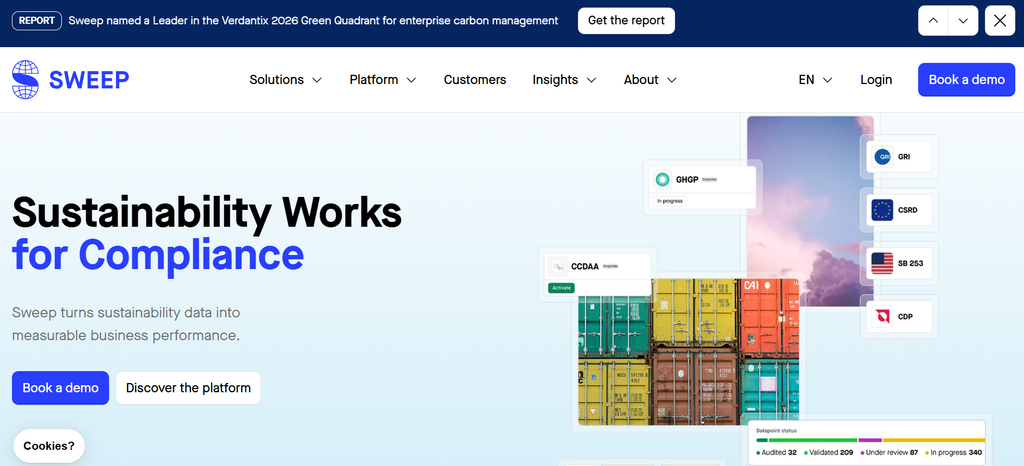
Sweep, the sustainability intelligence platform, is built for enterprises running complex programmes across multiple teams, entities and value chains.
It frames the problem as the Sustainability Execution Gap, meaning the distance between a stated Net Zero ambition and the fragmented data and processes that stop it from being executed.
The Sweep Tree data model is the differentiator worth understanding. It adapts to any organisational structure rather than forcing the business into a fixed hierarchy, which matters for groups that acquire, divest or reorganise between reporting cycles.
Reporting is not the end point. Sweep supports actionable decarbonisation planning on the same dataset, so reduction initiatives are modelled against the emissions data rather than in a separate tool.
Multi-framework reporting runs from a single trusted dataset. CSRD, CDP, GRI, ISSB, SFDR, SB 253 and 261, and TCFD are all served from one collection cycle rather than five, with audit-ready outputs and embedded domain expertise.
Supplier engagement is treated as a first-class problem rather than an export. Supplier portals, role-based access, and approval workflows are built in, addressing the collection bottleneck most enterprises hit on Scope 3 primary data.
Sweepy, the platform’s AI analytics layer, handles hotspot identification and predictive insight. Native integrations and APIs connect to ERP, procurement, HRMS, and financial systems, which moves sustainability data out of a reporting silo and into operational decisions.
The company was co-founded by Rachel Delacour, Yannick Chaze and Raphael Güller, previously of Zendesk and Bime Analytics.
Sweep is B Corp certified, a member of the World Bank’s Carbon Pricing Leadership Coalition and recognised by Verdantix, IDC MarketScape and MEDEF.
Suits: enterprises, mid-market companies, and financial institutions juggling several frameworks with heavy supplier data and complex entity structures.
Stops at: organisations wanting a single-framework calculator, where the platform is more than the task requires.
3. Watershed
Watershed structures its platform around measurement, reporting and action, with the emphasis on the third.
It suits teams that have their inventory under control and now need to run a reduction programme against it.
Its data foundation is CEDA, an extensive emission factor archive, supplemented by customer data and external databases including CDP, with full data lineage from source through output.
The action layer is what separates it. SBTi-aligned target modelling, hotspot identification at product and material level, and a marketplace of clean power and carbon removal projects sit inside the same platform.
Suits: large enterprises with experienced sustainability teams moving from measurement into funded reduction programmes.
Stops at: the full ESRS surface, since its coverage is strongest on climate and thinner on social and governance topics.
4. Persefoni
Persefoni was founded in 2020 on a specific premise: that emissions calculation should be treated with the discipline of financial accounting.
Investor-grade methodology documentation is the primary deliverable rather than a by-product.
The financial services focus is genuine rather than a module. It was purpose-built for financed emissions under Scope 3 Category 15 and the PCAF framework, with a financial-institution data model and the documentation discipline banks and asset managers need.
Its AI layer is embedded across every plan. Copilot runs on Persefoni’s own model, anomaly detection surfaces outliers across large datasets, and natural-language mapping parses spend files against emission factors.
Suits: banks, insurers, private equity firms and asset managers where financed emissions are the central measurement problem.
Stops at: decarbonisation programme management and multi-entity group data governance, both of which sit outside its design.
5. IBM Envizi
IBM Envizi is built for organisations where the volume and variety of environmental data is the core challenge rather than the reporting. Manufacturing, utilities, transport and large property portfolios are the natural fit.
It consolidates more than 500 ESG data types from siloed sources into a single auditable system of record, with a GHG Protocol-aligned emissions engine and embedded framework support. IBM was named a Leader in the Verdantix 2026 Green Quadrant for enterprise carbon management software.
Suits: asset-heavy organisations drowning in utility, meter and operational data before they get anywhere near a disclosure.
Stops at: teams whose challenge is framework complexity rather than data volume, where the emphasis sits elsewhere.
How to narrow the shortlist
Start with where the obligation sits internally. If disclosure is owned by finance and filed alongside financial statements, that points somewhere different from a sustainability team building a data foundation.
Then count your frameworks and your entities. One framework and one legal entity is a genuinely different problem from five frameworks across forty subsidiaries, and platforms are built for one or the other.
Finally, test three things in the demo rather than accepting the answer on the website. Ask to see double materiality assessment support, ESRS digital tagging, and the end-to-end assurance workflow, because every vendor says yes to CSRD support and the detail is where they diverge.
Conclusion
There is no single answer in this category, only a better or worse match for your starting point. Workiva suits finance-led disclosure, Watershed suits active reduction programmes, Persefoni suits financed emissions, and IBM Envizi suits asset-heavy data volume.
Sweep occupies the position most large enterprises actually find themselves in, which is multiple frameworks, multiple entities, and a supplier data problem that will not solve itself.
That combination is what the Sweep Tree model and the supplier workflows were designed around.
Work out which description fits your team, then take two into demos and ask both the same audit trail question. That comparison tells you more than any feature grid.
Frequently asked questions
What is the difference between carbon accounting software and a sustainability intelligence platform? A carbon accounting tool produces an emissions figure. An intelligence platform manages the data model, audit trail, supplier collection and framework mapping around that figure, and connects the output to operational decisions.
Does vendor heritage still matter? Yes, more than marketing suggests. Platforms that grew out of carbon accounting tend to be stronger on measurement and decarbonisation, while those that grew out of disclosure tend to be stronger on frameworks, controls and investor communication.
Do we need a specialist platform for financed emissions? If financed emissions are your primary exposure, generally yes. Several general platforms added portfolio modules, but a purpose-built financial data model carries deeper methodology and regulatory documentation.
How long does implementation take? It depends more on your data readiness than the platform. Organisations with clean source data move quickly, while those consolidating spreadsheets across subsidiaries should expect the data work to dominate the timeline.
What should we ask about audit readiness? Request a live trace of one filed figure back to its source data, emission factor, methodology version and approver. This capability is described well by almost every vendor and demonstrated poorly by some.