Table of Contents
Introduction
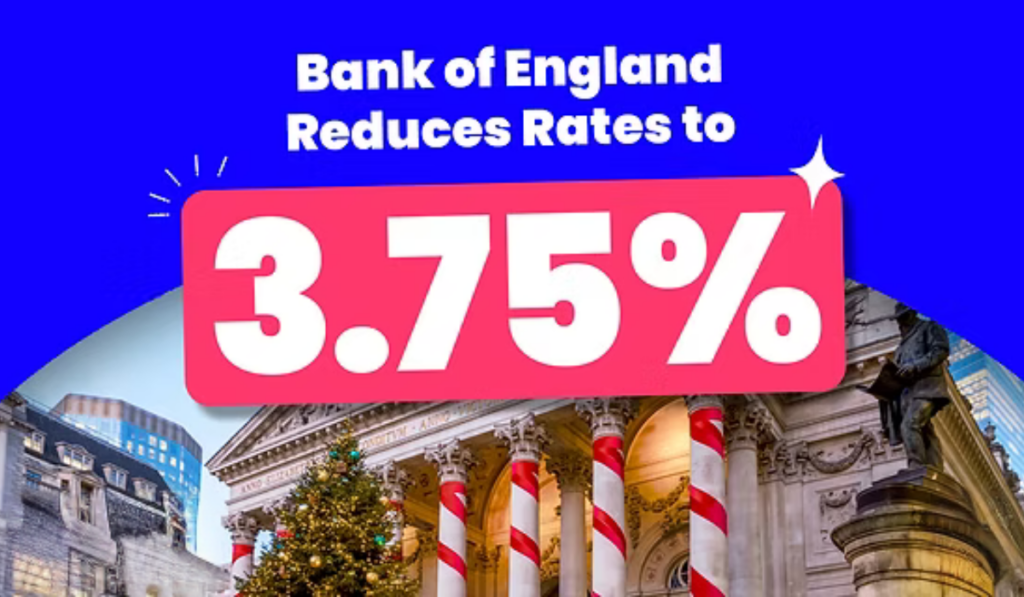
The Bank of England reduced its base rate to 3.75% on December 18, 2025, marking the fourth interest rate cut of the year. This move follows a series of reductions aimed at supporting economic growth amid falling inflation. Policymakers voted 5-4 to lower rates from 4%, signaling caution due to global uncertainties like U.S. tariffs. UK interest rate cuts ease borrowing costs but challenge savers, influencing mortgages, housing, and consumer spending.
Recent Timeline of UK Interest Rate Cuts
The Bank of England began its easing cycle in 2024, cutting from a peak of 5.25%. Key reductions include:
- February 2025: Base rate falls to 4.5% from 4.75%, the first cut of the year amid cooling inflation.
- May 2025: Further drop to 4.25%, responding to tariff threats and downbeat data.
- August 2025: Rate hits 4% after a divided MPC vote (majority for 0.25% cut).
- December 2025: Latest cut to 3.75%, with inflation nearing the 2% target.
This gradual path reflects the Bank’s strategy to balance growth and price stability. Since August 2024, six cuts have occurred, bringing rates to a 20-month low.
| Date | Base Rate Change | New Rate | Key Reason |
| Feb 6, 2025 | -0.25% | 4.50% | Cooling inflation |
| May 8, 2025 | -0.25% | 4.25% | Tariff impacts |
| Aug 7, 2025 | -0.25% | 4.00% | Demand softening |
| Dec 18, 2025 | -0.25% | 3.75% | Inflation at target path |
Reasons Behind UK Interest Rate Cuts
UK interest rate cuts stem from disinflation progress. Headline inflation hit 3.2% in November 2025, below forecasts, allowing the Bank to act. The 2% target now appears achievable by 2026, earlier than prior estimates. External factors like U.S. President Trump’s tariffs prompted preemptive easing to counter growth risks.
Governor Andrew Bailey emphasized a “gradual and cautious” approach, noting unpredictable global conditions. Divided votes (e.g., 5-4 in December) highlight debates over pace. Persistent pressures, like services inflation, temper faster cuts.
Domestic Indicators and Monetary Strategy
The latest rate cut follows clear moderation across core domestic indicators. Purchasing Managers’ Indices (PMIs) for both manufacturing and services dipped below 51 in late 2025, reflecting subdued expansion. Consumer credit growth slowed to its weakest pace since early 2023, underscoring more cautious household spending patterns. In response, the Bank seeks to avert a deeper slowdown that could push output growth below 1% in early 2026.
Household disposable incomes have gradually recovered thanks to lower energy prices and easing food costs, yet wage pressures remain uneven. As real income growth stabilizes, policymakers view moderate rate reductions as a way to ensure real borrowing costs continue to fall, encouraging investment and consumption without overheating demand.
At the same time, fiscal policy is providing limited support. The UK government’s 2025 Autumn Statement prioritized fiscal responsibility, meaning monetary policy has taken a leading role in sustaining momentum. This interplay between fiscal restraint and monetary accommodation has become a defining feature of the UK’s macroeconomic stance heading into 2026.
Global Context and Exchange Rate Effects
Internationally, the UK’s easing cycle aligns broadly with monetary trends across major central banks. The European Central Bank and Bank of Canada also moved toward rate cuts as inflation cooled, creating a synchronized easing wave. However, the U.S. Federal Reserve’s more cautious stance—due partly to persistent consumer demand—has widened the interest rate gap. As a result, sterling experienced mild depreciation against the dollar, trading near $1.21 by late December 2025.
A weaker pound, while supportive for exporters, raises questions about imported inflation, particularly for energy and raw materials. The MPC’s November minutes acknowledged this trade-off but concluded that domestic price dynamics would dominate in the medium term. The exchange rate effect is therefore being monitored but not seen as an obstacle to further easing unless sterling falls sharply in early 2026.
Economic Impacts of Rate Reductions
Lower rates stimulate demand but risk reigniting inflation. Goldman Sachs notes housing channels amplify effects, potentially dragging GDP by 0.7% from prior highs. Recent cuts support recovery, with forecasts for 2026 easing to 3% possible.
In financial markets, gilt yields declined to their lowest levels since 2022, reducing government borrowing costs and enhancing investor appetite for risk assets. Corporate bond spreads narrowed, reflecting improved confidence in credit conditions. Small and medium-sized enterprises (SMEs), often most sensitive to borrowing costs, are expected to benefit from lower repayments and increased credit access.
- Inflation Control: Cuts help if demand weakens, but one-off budget measures may lift prices temporarily.
- GDP Growth: Easing counters sluggishness, though tariffs pose headwinds.
- Employment: Softer job market aids cuts without wage spirals.
Effects on Mortgages and Housing Market
UK interest rate cuts directly lower mortgage costs. Tracker and variable-rate holders benefit immediately. For a £125,000 mortgage over 25 years, December’s cut saves £18 monthly; £400,000 saves £58.
Around 900,000 fixed deals expire soon, facing lower re-fix rates. Halifax adjusts variable rates from February 2026. Housing activity may rise as affordability improves, reversing high-rate drags.
| Mortgage Type | Impact of 0.25% Cut |
| Tracker (£125k) | -£18/month |
| Tracker (£400k) | -£58/month |
| Fixed Expiring | Lower new rates available |
Implications for Savings and Investments
Savers face declining returns. Easy-access rates averaged 2.67% pre-December cut. Fixed savings yields fall slower but trend down. Investors shift to bonds or equities for yield.
Pension funds benefit from lower liability costs. Wealth managers see opportunities in rate-sensitive assets amid 2026 forecasts.
Business and Consumer Confidence Boost
Cuts signal economic stabilization, lifting sentiment. Businesses borrow cheaper for expansion; consumers spend more on big-ticket items. Berenberg predicts faster 2026 disinflation, supporting the end-year rate at 3%.
Future Outlook: Bank of England Forecasts
Markets price three more cuts into 2026, potentially to 3%. Inflation returns to 2% mid-year if trends hold. Tembo experts eye 3.75% as base, with risks from budgets or geopolitics.
The Bank stresses data-dependence, watching services inflation and global trade.
Conclusion
UK interest rate cuts to 3.75% in 2025 mark a pivotal easing phase, balancing growth against inflation risks. Borrowers gain most via cheaper mortgages, while savers adjust strategies. Monitor MPC meetings for 2026 path amid uncertainties.