

Table of Contents


Large carriers run enough freight volume that manual dispatch decisions genuinely cost money. A dispatcher spending 30 minutes evaluating a load, or a back office team re-keying the same data across three systems, adds up fast once a fleet crosses into the hundreds of trucks.
This guide compares three AI-native transportation management systems specifically built to handle that scale, based on what each vendor actually documents about its own capabilities.
Top 3 AI TMS Platforms for Large Carriers
1. PCS Software (Cortex AI)

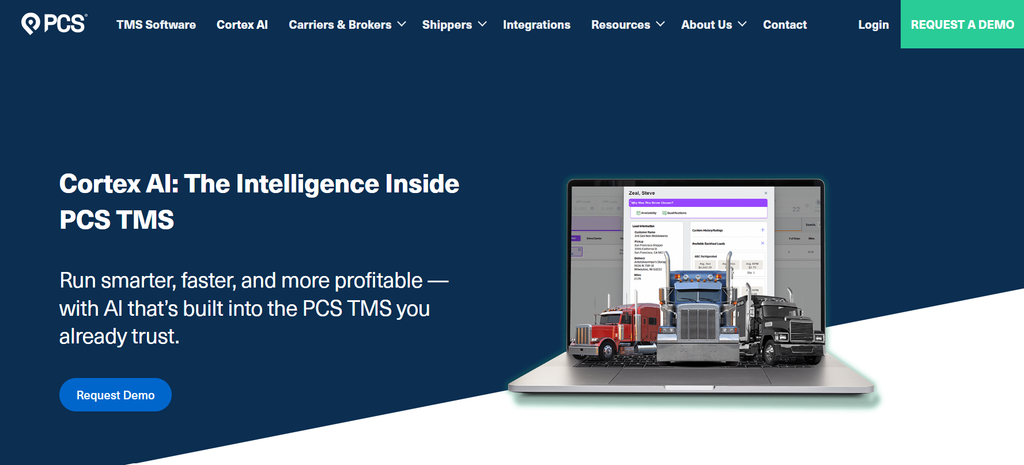
Cortex AI is built natively into the PCS TMS platform rather than added on as a separate tool, drawing on freight operations expertise built up since PCS Software was founded in 1996. It is trained on transportation data and industry knowledge rather than general internet text. Its Load Opportunity Management feature captures freight from emails, documents, EDI, and load boards, then scores each one by profitability so dispatchers can act on the most profitable loads first.
On the dispatch side, Cortex recommends the best driver and equipment match using more than 36 data points, cutting tender-to-dispatch time from hours to minutes with one-click reserve or dispatch.
Its Backhaul Booster identifies return legs within a carrier’s own network and automatically emails or calls shippers with offers, directly reducing deadhead miles and raising revenue per mile. A natural language search feature lets dispatchers ask plain-English questions like “show loads where RPM is over $3” rather than building filters manually.
Beyond load matching, Workflow Automation handles the busywork around a dispatch, auto-creating loads, managing documents, and triggering assignments without a dispatcher touching each step manually, while a separate Real-Time Insights layer runs predictive analytics that flag developing issues before they actually cost margin, rather than surfacing a problem only after it has already affected a load.
The platform is designed to scale from a few dozen trucks up to enterprise fleets, and every recommendation it makes comes with its reasoning attached, whether that is deadhead, hours of service or lane history, so a dispatcher can act on the call or override it. Tim Reilly of Voyager Express, a PCS customer, said Cortex gives fleets like his enterprise-level technology that was previously available only to the largest carriers
2. McLeod Software (LoadMaster and PowerBroker)
McLeod Software has served as the reference point for large truckload carriers for decades, with its LoadMaster and PowerBroker platforms best suited for fleets running roughly 500 or more trucks. Its AI investment centers on RespondAI, which prioritizes and drafts responses to inbound communications, cutting response times the company reports dropping from around 30 minutes to seconds.
MPact.Rate, McLeod’s market analysis layer, is built on rate data contributed nightly by active McLeod carriers and brokers, covering both the buy and sell sides of a transaction using only rates from freight that actually moved.
The company has also partnered with autonomous trucking developer Aurora Innovation, allowing McLeod customers to dispatch and manage self-driving trucks through the same TMS interface, with dedicated carrier Russell Transport becoming the first customer to manage an autonomous freight move through the integration.
3. Trimble TMS (TMW.Suite and TruckMate)
Trimble’s enterprise TMS lineup, built from TMW.Suite for full truckload carriers and TruckMate for LTL and intermodal operations, is the platform behind what Trimble states is 60 percent of the top 200 fleets in North America. Its Dispatch Advisor identifies the best driver and load match using multiple variables at once, including location, remaining hours of service, and delivery time windows, rather than requiring a planner to check each factor separately.
Trimble’s newer Arc Agent extracts freight order information directly from PDF and text files and submits it into TMW.Suite without manual entry, and the same agent is built to extend across Trimble’s other TMS products using a shared catalog of skills rather than separate tools for each task.
The company’s Freight Marketplace adds AI-enhanced carrier vetting on top of direct shipper access, connecting carriers to freight from shippers including Procter & Gamble.
Trimble’s TMS suite has decades of history in the trucking industry, and its scale shows in its customer base: carriers running anywhere from 50 trucks to several thousand use some version of the platform, though the AI-specific tooling is concentrated in the enterprise-tier TMW.Suite product.
What to Look for Before Choosing an AI TMS
Depth of AI integration varies more than it might appear from a features list. Some platforms build AI natively into core dispatch and pricing decisions, while others layer AI-branded add-ons onto workflows that still require significant manual verification.
That split is not unique to freight software. The same divide runs through customer service automation and most other categories where vendors have rushed to attach AI to existing products, and the test is the same everywhere: does the system make a decision, or does it prepare one for a human to make anyway?
Asking a vendor to walk through a real load from intake to dispatch, rather than just describing features in the abstract, tends to reveal the difference quickly.
Implementation timeline is worth weighing just as heavily as feature depth for a large carrier. Enterprise-tier platforms in this category generally involve a longer rollout than smaller TMS tools, and that tradeoff is usually worth it only if the fleet is genuinely operating at a scale where manual dispatch has become the bottleneck.
Conclusion
All three platforms here treat AI as core infrastructure rather than an add-on, which sets them apart from TMS tools where AI is layered on top of an otherwise unchanged workflow. Cortex AI leans toward native scaling, running from fleets of a few dozen trucks up to enterprise size on the same platform, McLeod brings decades of large-carrier market presence alongside its RespondAI and MPact tools, and Trimble offers the deepest bench of AI agents spread across its TMW.Suite and TruckMate products specifically.
The right fit depends less on which platform has the longest feature list and more on which one’s AI actually sits inside the decisions a large carrier’s dispatch team makes every single day.
Frequently Asked Questions
1. What makes an AI TMS different from a traditional transportation management system?
A traditional TMS mainly records what has already happened, such as a booked load or a sent invoice. An AI TMS actively analyzes that same data to recommend or automate decisions, like which driver should take a load or which freight is most profitable to accept.
2. How many trucks does a fleet need before an enterprise AI TMS makes sense?
This varies by platform, but the three systems compared here are generally built for carriers running from the low hundreds of trucks up into the thousands, where manual dispatch decisions start to create real bottlenecks.
3. Do these platforms require a dedicated IT team to implement?
Enterprise-tier TMS platforms in this category typically involve a more significant implementation process than smaller TMS tools, and larger carriers often do dedicate internal resources to the rollout, though the specific requirements vary by vendor and fleet complexity.
4. Can an AI TMS work with autonomous trucks?
At least one platform in this comparison, McLeod Software, has a direct integration with an autonomous trucking developer, allowing dispatch and management of self-driving trucks through the same TMS interface used for traditional dispatch.